
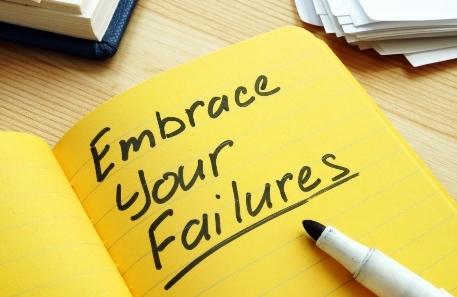
bizvantagehub.com – In a world obsessed with success stories, highlight reels, and overnight wins, failure is often treated like a disease to be avoided at all costs. Yet the most successful people across every field — entrepreneurs, scientists, athletes, artists, writers — share one surprising truth: they failed far more often than the average person. The real difference? They learned to embrace failure as learning rather than seeing it as a verdict on their worth.
Why We Fear Failure So Much
From early childhood, many of us are conditioned to believe:
- Failure = bad
- Success = good
- Mistakes = shame
School grades, parental expectations, social media comparison, and workplace performance reviews all reinforce this binary thinking. The result? We develop a fixed mindset (Carol Dweck’s term) where we see abilities as static traits. When we fail, it feels like proof we’re “not good enough.”
But high achievers operate with a growth mindset. They view failure not as evidence of inadequacy, but as data — valuable, sometimes expensive, but extremely useful information.
Famous Failures That Became Legendary Successes
| Person/Company | Notable Failure(s) | What They Learned & How It Led to Success |
|---|---|---|
| Thomas Edison | ~10,000 unsuccessful attempts at the light bulb | “I have not failed. I’ve just found 10,000 ways that won’t work.” |
| J.K. Rowling | 12 publisher rejections of Harry Potter | Perseverance + refinement of craft → global phenomenon |
| Airbnb | Cereal box funding, near bankruptcy in 2008 | Radical customer focus → $100B+ company |
| Michael Jordan | Cut from high school varsity basketball team | “I’ve failed over and over… That’s why I succeed.” |
| SpaceX (early rockets) | First 3 launches exploded | Rapid iteration philosophy → reusable rockets & Starlink |
| Sara Blakely (Spanx) | Dozens of rejections from manufacturers | “My dad used to ask what I failed at that week.” |
Every iconic success story hides a graveyard of failures behind it.
The Science: How Failure Actually Builds the Brain
Neuroscience confirms what high performers intuitively know:
- Failure activates deeper learning circuits When something goes wrong, the brain releases more dopamine in response to unexpected errors than to expected success. This “error signal” makes us pay closer attention and remember the lesson longer.
- Struggle creates stronger neural connections Effortful problem-solving (after failure) produces more myelin — the insulation that makes neural pathways faster and more efficient.
- Post-failure reflection accelerates mastery Studies show people who spend time analyzing what went wrong outperform those who simply try again without reflection.
In short: biologically, the brain is wired to learn more from failure than from easy success.
Practical Ways to Embrace Failure as Learning (2026 Mindset)
- Reframe the language immediately Instead of: “I failed.” Say: “That didn’t work. What can I learn?”
- Do a quick “Failure Post-Mortem” (5-minute version)
- What were my assumptions?
- Which of them were wrong?
- What would I do differently next time?
- What small experiment can I run tomorrow?
- Celebrate the attempt, not just the outcome Reward yourself for courage and action. Many top performers give themselves a “failure reward” (coffee, walk, favorite song) after a big setback.
- Build a “Failure Resume” Write down every significant rejection, mistake, and flop. Review it when you’re feeling stuck — it’s proof of your resilience and growth.
- Surround yourself with people who normalize failure The fastest way to change your relationship with failure is to spend time with people who talk openly about theirs.
- Use the “Yet” mindset “I’m not good at this… yet.” One tiny word that keeps the door open to future growth.
The Paradox of Modern Success
In the age of AI, automation, and rapid change (2026 reality), the ability to fail fast, learn faster, and pivot has become one of the most valuable skills a human can have. Machines are getting better at getting things right the first time. Humans remain uniquely good at:
- Trying crazy things
- Failing in interesting ways
- Extracting wisdom from those failures
- Adapting creatively
That messy, uncomfortable process is exactly what AI still can’t fully replicate.
Final Thought
Failure is not the opposite of success. Failure is the tuition you pay for success.
The sooner you stop trying to avoid it and start mining it for lessons, the faster your growth accelerates.
So next time something goes wrong — a rejected proposal, a crashed startup, a bad presentation, a relationship that ends, a product that flops — take a deep breath and smile a little.
You just paid the tuition. Now go collect the education.
Embrace the failure. Harvest the learning. Keep moving forward.
You’re not failing. You’re leveling up — the hard way, the real way, the only way that actually sticks.